Erminio

Kein Aprilscherz
Seit Tagen sahen wir es kommen und leider hat sich die Vorhersage die ganze Zeit gehalten: Am ersten April, einem Mittwoch, sollte es heftig aus Südost wehen mit Böen bis über 50 kn. Ein pensionierter Seemann, den wir bei Yorgos kennengelernt haben, meinte dazu: „Wenn 10 Bft angesagt sind, aus dieser Richtung, dann können es sogar 12 werden, dann ist alles möglich…“
No April Fool's Joke
We had been seeing it coming for days, and unfortunately the forecast held true the whole time: on 1 April, a Wednesday, there was to be a strong south-easterly wind with gusts of over 50 knots. A retired sailor we met at Yorgos’s place remarked: “If they’re forecasting force 10 winds from that direction, it could even reach force 12 – then anything is possible…”
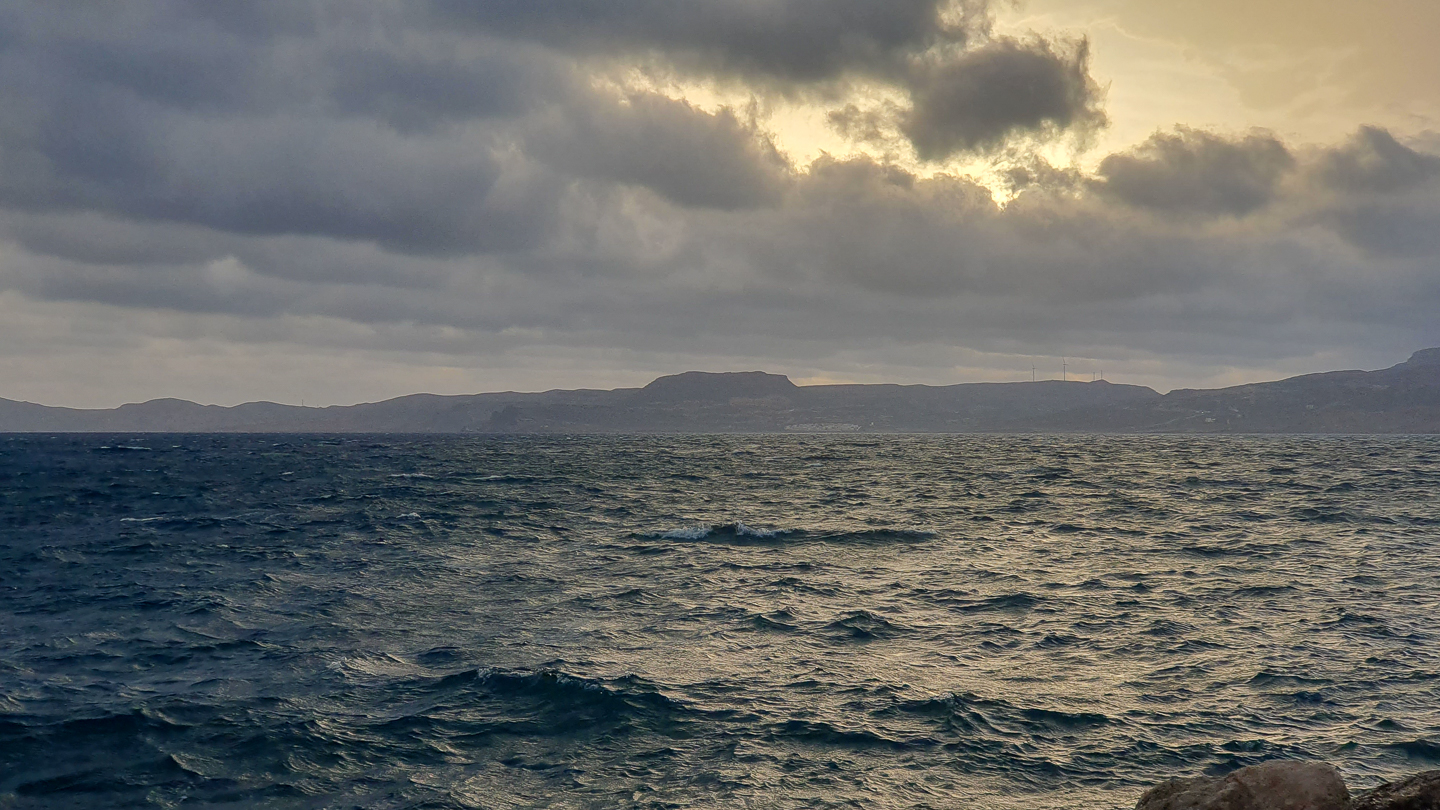
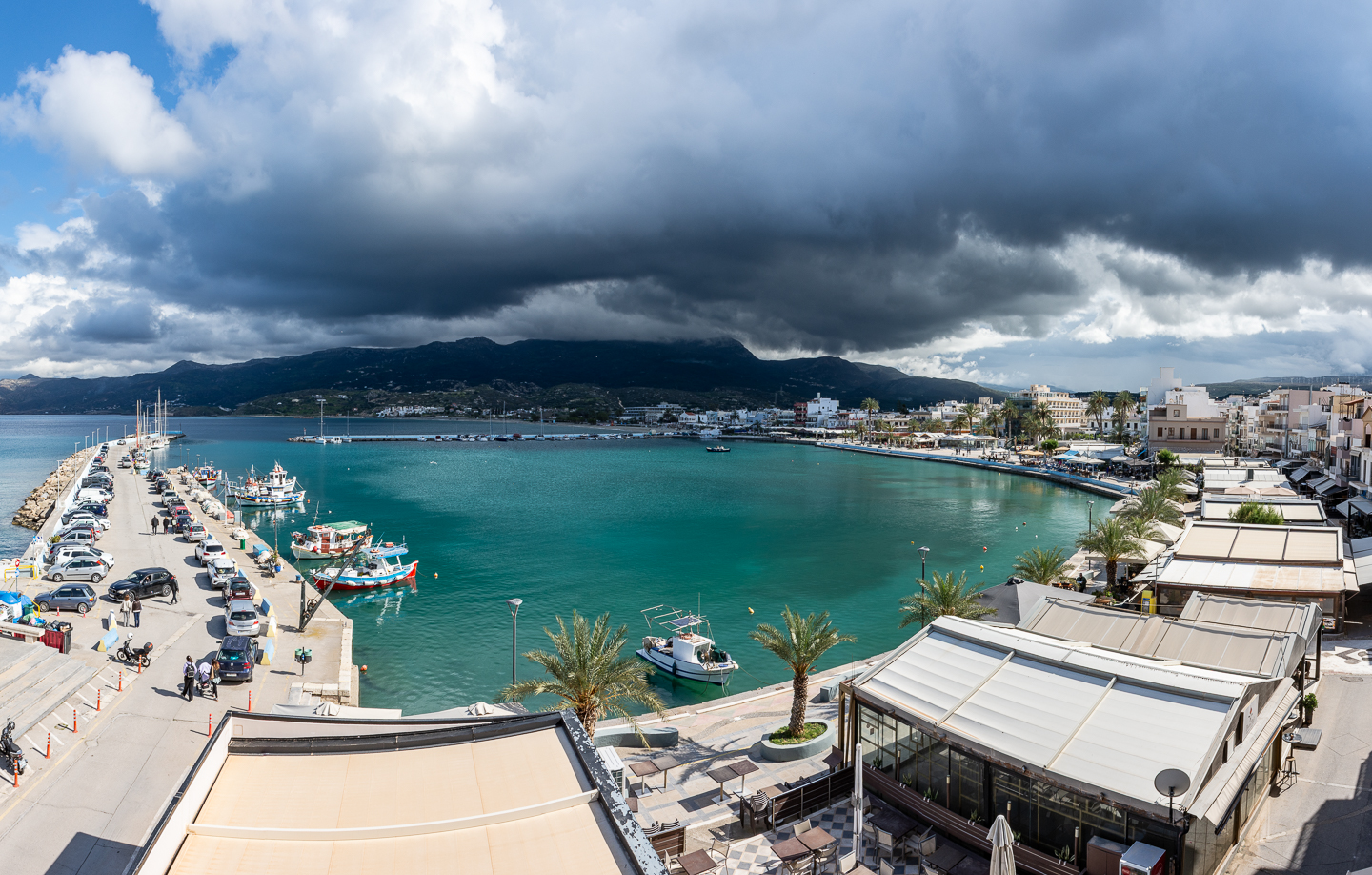
Noch schaut es recht ruhig aus
It still looks fairly quiet
Am Dienstagnachmittag beginnen die Vorbereitungen. Wir bringen eine Spring an der Ankertrosse an, damit der seitlich ausgebrachte Anker weiter vorne ansetzt und den Bug stärker von dem Pier wegzieht. Die Festmacher werden verstärkt und etwas loser genommen, weil das Boot Platz zum Stampfen braucht, wenn die Wellen bei der Hafeneinfahrt hereinrollen.
Der Wind hat auch am Dienstag schon nach ONO gedreht und der Schwell ist bereits gut spürbar im Hafenbecken, aber zunächst schaut alles ganz gut aus. Wir sind froh, dass wir das Apartment bis Freitag verlängert haben, an Bord ist es jetzt schon ziemlich ungemütlich. – Noch können wir uns nicht vorstellen, was auf uns zukommt.
Preparations begin on Tuesday afternoon. We attach a spring line to the anchor line so that the anchor, which is set to the side, catches further forward and pulls the bow further away from the pier. The mooring lines are reinforced and loosened slightly, as the boat needs room to heave when the waves roll in through the harbour entrance.
By Tuesday, the wind has already shifted to the ENE and the swell is already quite noticeable in the harbour basin, but for now everything looks quite good. We’re glad we’ve extended our stay in the apartement until Friday; it’s already quite uncomfortable on board. – We still can’t imagine what lies ahead of us.
11:30
Um halb sieben schaue ich zum ersten Mal zum Hafen, es bläst stark, aber noch sieht alles harmlos aus. Nach dem Frühstück gehen wir beide zum Boot und reden mit Gustav, dessen Boot in Luv von uns liegt. Ich habe ihm gestern eine unserer Festmacherleinen geborgt, nur zur Sicherheit … Bis jetzt ist alles halb so wild, daher gehen wir wieder ins Hotel und bitten Gustav, der an Bord bleibt, uns anzurufen, wenn sich die Lage ändert.
15 Minuten später kommt schon sein Anruf. Die Situation ist eskaliert, es wäre gut, wenn wir gleich wieder herunterkämen. Als wir zum Hafen zurückkommen, ist dort die Hölle los. Die Böen pfeifen uns um die Ohren, die Luft ist voller Gischt, die Wellen, die hereinkommen, bringen die Boote zum Tanzen, egal, ob sie vier oder vierzehn Tonnen wiegen.
At half past six I take my first look towards the harbour; it’s blowing hard, but everything still looks harmless. After breakfast, we both head down to the boat and speak to Gustav, whose boat is moored to windward of ours. I lent him one of our mooring lines yesterday, just to be on the safe side… So far, it’s not too bad, so we go back to the hotel and ask Gustav, who’s staying on board, to ring us if the situation changes.
Fifteen minutes later, his call comes through. The situation has escalated; it would be best if we came back down straight away. When we return to the harbour, all hell has broken loose. The gusts are whistling past our ears, the air is full of spray, and the waves rolling in are making the boats dance, regardless of whether they weigh four or fourteen tonnes.
Arbeit an den Leinen
Working on the ropes
Wir bemerken mit Schrecken, dass die Spring an der Ankertrosse nicht gehalten hat. Dadurch fehlt jetzt der Zug weg von der Mauer und Pepperbird sitzt mit der Scheuerleiste immer wieder auf den fix montierten Gummifendern an der Hafenmauer auf. Irgendwann kracht es zum ersten Mal und ein Stück der Leiste ist weggebrochen. Yorgos – unser Repräsentant über den Winter – kommt auch zum Boot und ist genauso hilflos wie wir alle.
Inzwischen sind Fischer und freiwillige Helfer am Hafen eingetroffen, die unter der Leitung des Chefs der Hafenpolizei mit der Sicherung der Yachten beginnen. Aus dem Augenwinkel nehme ich wahr, dass es anderen Booten noch schlechter geht als unserem (auch von vorne kommt das Geräusch von brechendem Holz, dort beginnen die Helfer mit ihrem Einsatz).
We realise with horror that the spring line hasn’t held on the anchor line. As a result, there’s no longer any tension away from the quay wall, and Pepperbird keeps bumping its rubbing strake against the permanently fitted rubber fenders on the quay wall. Eventually, there is a crash for the first time and a piece of the strip has broken off. Yorgos – our representative for the winter – also comes over to the boat and is just as helpless as the rest of us.
Meanwhile, fishermen and volunteers have arrived at the harbour and, under the direction of the harbour police chief, are beginning to secure the yachts. Out of the corner of my eye, I notice that other boats are in even worse shape than ours (the sound of breaking wood is coming from the front too; that’s where the helpers are starting their work).
12:47
Da ich den Eindruck habe, dass unsere Leinen etwas zu dicht geholt sind, gehe ich bei einer ruhigeren Phase an Bord um sie etwas zu lösen. Als ich wieder am festen Boden bin, brechen die Heckleinen unseres Nachbarn in Luv und „Big Hugo“ (ja, so heißt das kleine Boot) kollidiert Bug an Bug mit der „Pepperbird“. Dabei wird der Anker aus seiner Halterung gehoben und der Bugkorb wird verbogen.
Wir bekommen gerade noch eine der Heckleinen zu fassen und Gustav, Hanna, Yorgos und ich, versuchen, „Big Hugo“ von unserem Boot wegzuziehen, aber unsere Kraft reicht dazu nicht aus. Immer wieder wird uns die Leine aus den Händen gerissen, die Boot stoßen zusammen und wir beginnen von vorne. Als wir beinahe aufgeben möchten kommen uns ein paar Helfer zu Hilfe und sorgen dafür, dass „Big Hugo“ wieder „an die Leine gelegt“ wird.
As I get the impression that our lines are a bit too tight, I go on board during a calmer spell to slacken them slightly. Just as I’m back on solid ground, our neighbour’s stern lines on the windward side snap, and ‘Big Hugo’ (yes, that’s the name of the little boat) collides bow-to-bow with the ‘Pepperbird’. In the process, the anchor is lifted out of its holder and the bow railing is bent.
We just manage to grab one of the stern lines, and Hugo, Hanna, Yorgos and I try to pull “Big Hugo” away from our boat, but we don’t have enough strength. Time and again, the line is snatched from our hands, the boats bump into each other, and we start all over again. Just as we are about to give up, a couple of fishermen come to our aid and ensure that “Big Hugo” is “put back on the leash”.
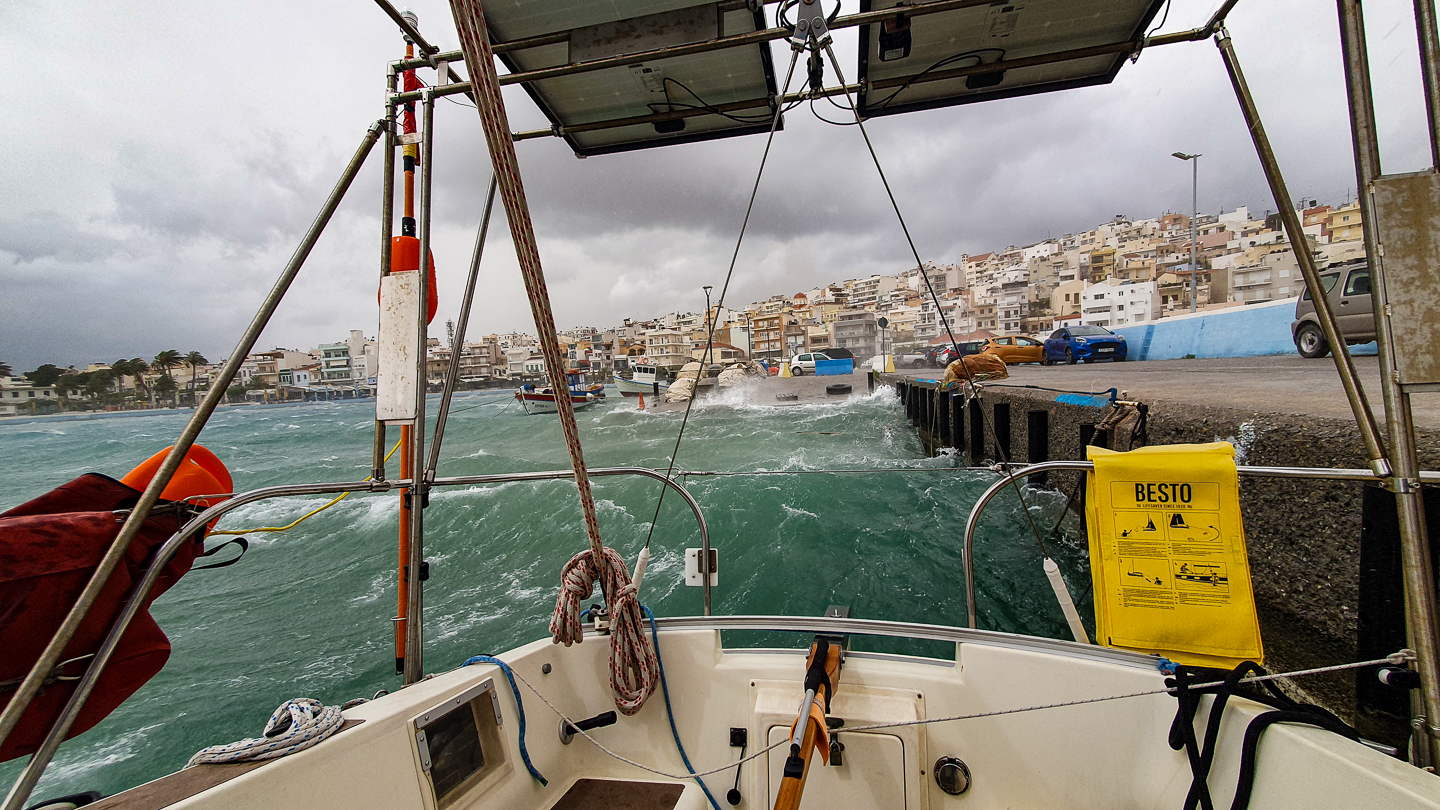
Aus dem Cockpit
From the cockpit
Einer der Männer erklärt mir, dass sie sich zunächst um unseren Nachbarn kümmern werden, was ja schließlich auch uns zugutekommt, anschließend würde sie dann uns helfen, das Boot weiter abzusichern. Inzwischen splittert immer mehr von der Scheuerleiste weg, es fehlen schon fast drei Meter …
Der Anker hängt noch immer an der Kette unkontrolliert vom Bug, da muss etwas geschehen! Also gehe ich wieder an Bord (das hört sich einfacher an, als es ist) und hole die Kette ein. Ich sitze dabei auf dem zusammengerollten Dinghi und komme mir vor wie beim Rodeo, so wild hüpft und stampft der Bug unter mir. Immer wieder muss ich die Arbeit unterbrechen, um mich festzuhalten, aber schließlich ist der Anker gesichert und kann den Rumpf nicht mehr beschädigen.
One of the men explains to me that they will first take care of our neighbour – which, after all, will benefit us too – and then they will help us to secure the boat further. Meanwhile, more and more of the rubbing strake is breaking away; almost three metres are already missing…
The anchor is still hanging uncontrollably from the bow on its chain – something has to be done! So I climb back on board (which sounds easier than it is) and haul in the chain. Sitting on the rolled-up dinghy, I feel like I’m on a rodeo, the bow is bouncing and thumping so wildly beneath me. I have to stop what I’m doing time and again to hold on tight, but eventually the anchor is secured and can no longer damage the hull.
Hier kommt die Sahara…
Here comes the Sahara…
Als das geschafft ist, wende ich mich dem seitlichen Anker zu. Nachdem sich die Spring gelöst hatte, bekam die Trosse mehr Lose und konnte das Boot nicht mehr halten. Ich hole etwas von der Trosse ein und bemerke, dass der Anker noch immer festsitzt. Ich ziehe uns so weit als möglich an den Anker heran, kann aber bei den heftigen Bewegungen die Leine nicht festmachen – ich brauche Hilfe!
Nun ist auch eine Gruppe von Helfern bei unserem Boot, angelangt, was ich mit Erleichterung bemerke. Yorgos, der wegen des Sturmes bei seiner Familie gebraucht wird, ist mittlerweile wieder abgezogen. Ich rede den Mann von vorhin wieder an und erkläre ihm, dass der Anker hält, ich aber Hilfe brauche, um ihn ordentlich festzumachen.
Once this is done, I turn my attention to the side anchor. After the spring line came loose, the anchor line slackened and could no longer hold the boat in place. I pull in some of the line and notice that the anchor is still holding. I haul us as close to the anchor as possible, but with all the violent movement I am unable to secure the line to the cleat – I need help!
Now a group of helpers has also arrived at our boat, which I notice with relief. Yorgos, who is needed by his family because of the storm, has since left again. I speak to the man from earlier again and explain to him that the anchor is holding, but I need help to secure it properly.
…und jetzt ist sie da!
…and now it is here!
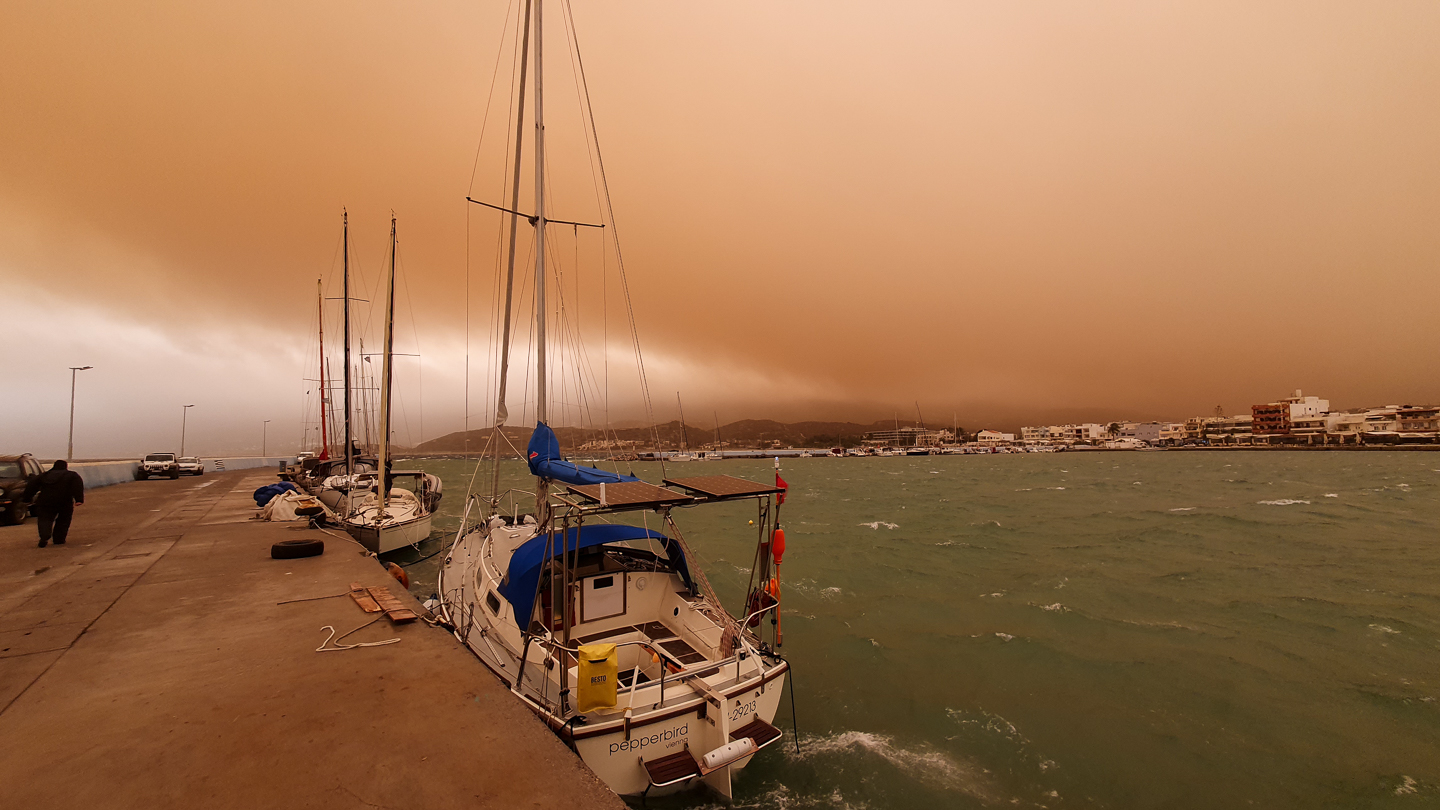
Ich sehe mich nach Hanna um, und bemerke, dass sie von den zwei, drei Wolkenbrüchen, die über uns hinweggezogen sind, völlig durchnässt ist – ich habe kaum etwas vom Regen wahrgenommen. Einige Leute sind mit ihren Autos da, und setzen sich, weil die meisten Boote schon gesichert sind, ins Trockene. Hanna wird schließlich von Gustav eingeladen, in seinem Auto Platz zu nehmen, aber da ist sie schon komplett eingeweicht.
Gemeinsam mit dem Bruder des Polizeichefs (wie sich später herausstellt) wird der Seitenanker an der Bugklampe befestigt und dicht geholt. Die Bug- und Heckleinen werden verdoppelt, verlängert und flacher gesetzt, wodurch die Pepperbird noch mehr Freiheit zum Bewegen hat. Zusammen mit dem neu gesetzten Anker ist sie damit gegen weitere Beschädigung gesichert.
I look around for Hanna and notice that she is completely soaked from the two or three downpours that have passed over us – I’ve hardly noticed the rain myself. A few people have arrived in their cars and, as most of the boats are already secured, take a seat in the dry. Hanna is eventually invited by Gustav to get into his car, but by then she is already completely wet through and through.
Together with the police chief’s brother (as it turns out later), the side anchor is attached to the bow cleat and hauled in tight. The bow and stern lines are doubled, lengthened and set flatter, giving the Pepperbird even more freedom of movement. Together with the newly set anchor, she is thus secured against further damage.
Nach dem Sturm?
After the Storm?
Wenn man sich die Aufnahmedaten der Videos anschaut, dann bemerkt man, dass es um 11:30 noch und um etwa 15:30 schon wieder relativ ruhig war. Das ganze Drama spielte sich also innerhalb von etwas über drei Stunden ab. Danach waren die Boote gut abgesichert, der Wind drehte immer mehr nach Süd, was den Schwell recht rasch beruhigte. Mit dem Südwind kam allerdings der Staub und das war wieder ein ganz eigenes Schauspiel …
If you look at the video timestamps, you’ll notice that things were still relatively calm at 11.30 and had settled down again by around 15.30. So the whole drama unfolded over a little over three hours. After that, the boats were safely secured, and the wind veered increasingly south, which calmed the swell down quite quickly. However, the southerly wind brought with it dust, and that was a spectacle in its own right…
Weltuntergang?
Armageddon?
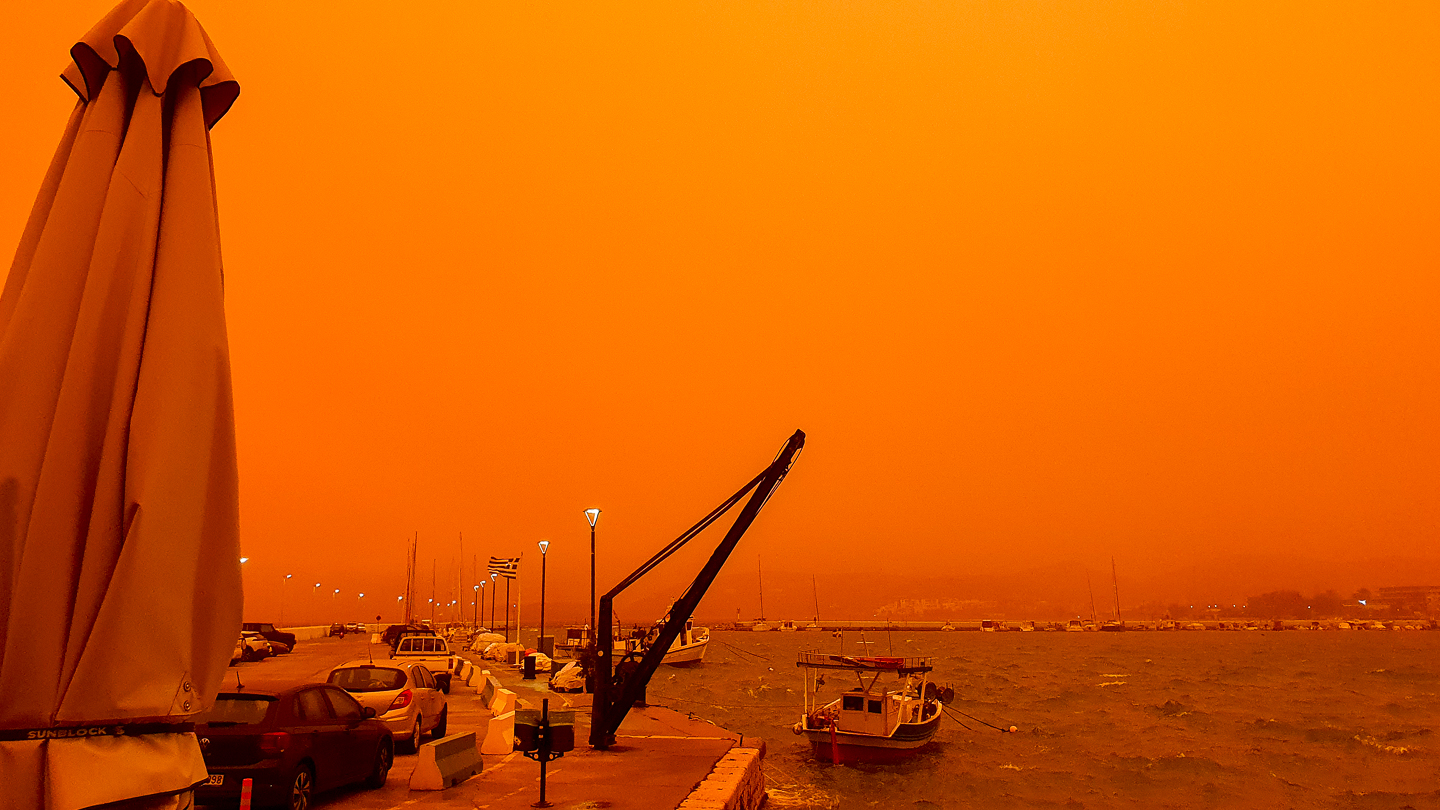
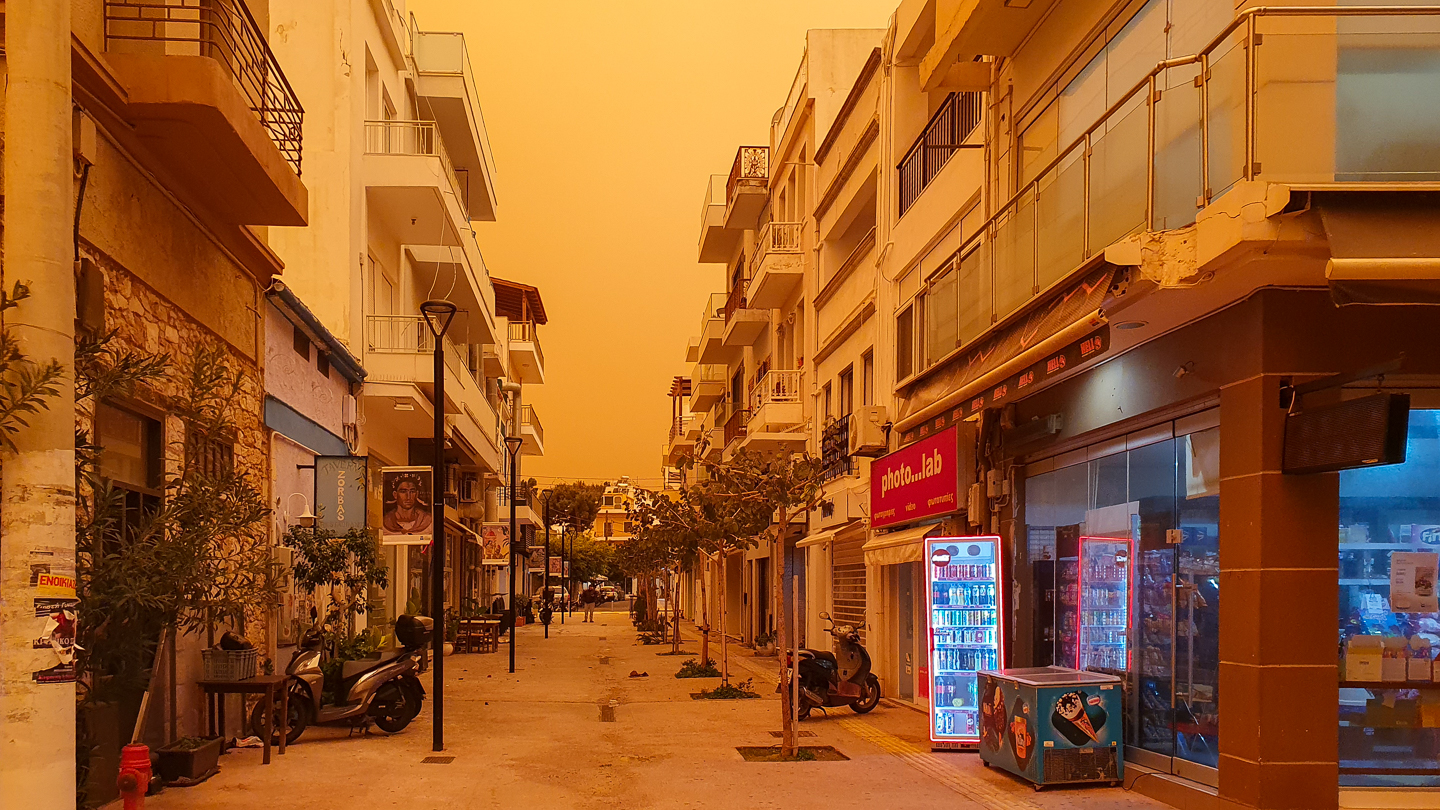
Im Stadtzentrum
In the city centre
Was haben wir gelernt?
Bis zu Mittag am 01. April 2026 hatten wir keine Ahnung wie ein Sturm am Meer wirklich aussieht. Wenn es stimmt, dass die Spitzen mit 60 Knoten gemessen wurden, dann hatten wir einen Orkan erlebt. Das muss ich kein zweites Mal sehen, egal wo unser Boot festgemacht ist!
Beim Festmachen hatten wir grundsätzlich die richtige Strategie gewählt, aufgrund mangelnder Erfahrung und Kompetenz aber nicht korrekt umgesetzt. Statt der „Spielerei“ mit der Spring hätte ich den Anker besser gleich am Vorschiff festgemacht. „Lang, lose, flacher Winkel …“ jetzt weiß ich, wie die Leinen aussehen müssen, wenn sie einem Sturm standhalten sollen.
What have we learnt?
Until midday on 1 April 2026, we had no idea what a storm at sea really looked like. If it’s true that peak winds of 60 knots were recorded, then that means we experienced a hurricane. I don’t want to see that again, no matter where our boat is moored!
When securing the boat, we’d basically chosen the right strategy, but due to a lack of experience and expertise, we didn’t implement it correctly. Instead of “playing around” with the spring line, I should have secured the anchor straight away at the bow. “Long, loose, flat angle…” now I know what the lines should look like if they are to withstand a storm.
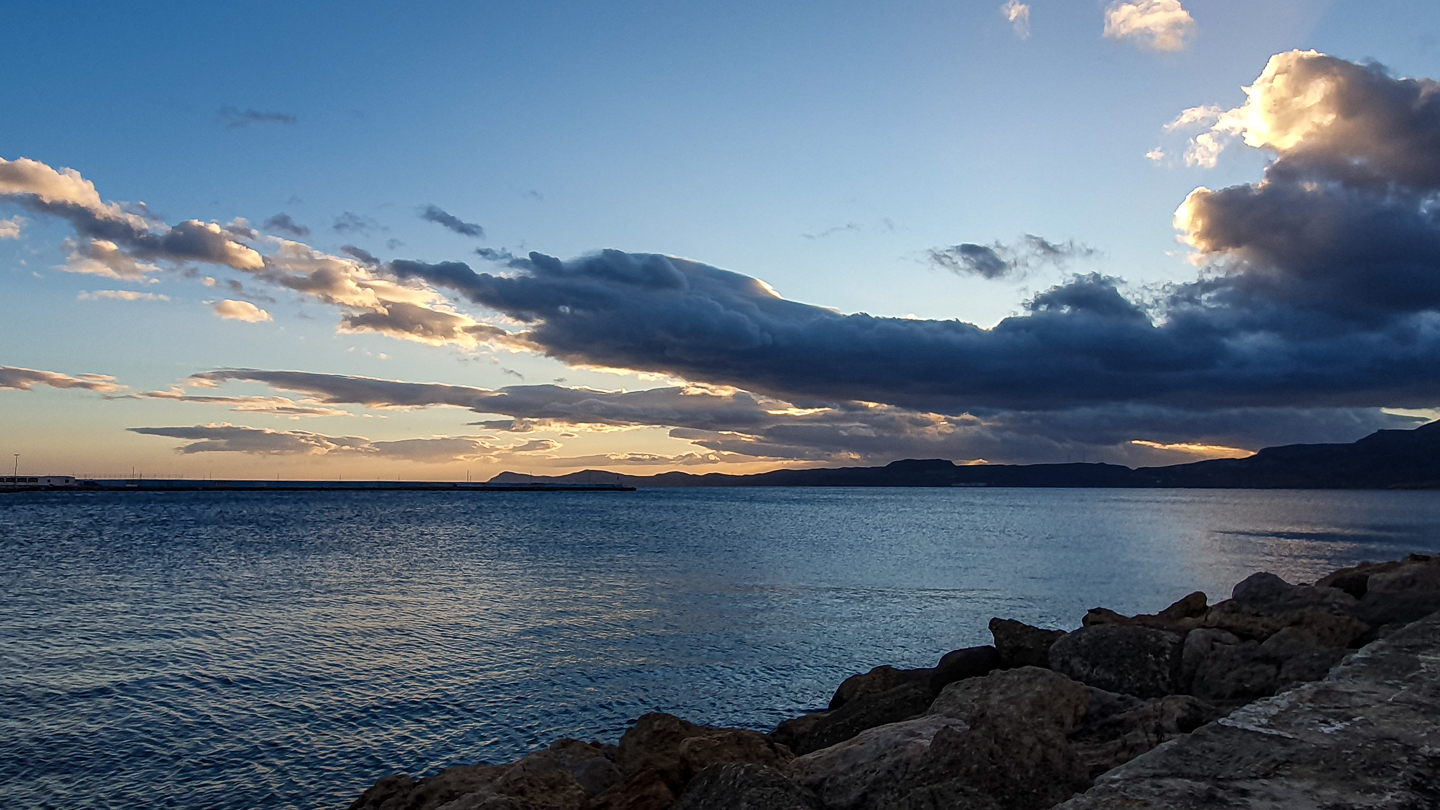
Der Morgen danach:
The morning after:
Nachbemerkung
Der Sturm und der darauffolgende Sandsturm waren allerdings nicht das Einzige, was mich an diesem Tag fasziniert hat. Der Umstand, dass – und die Art und Weise, wie die Leute von Sitía mit absoluter Selbstverständlichkeit zum Hafen kamen, um sich um die Boote von wildfremden Menschen zu kümmern, war beeindruckend. Es wurde zwar viel herumgeschrien und geflucht (zum Glück haben wir nichts davon verstanden), aber am Ende wurde vor allem zusammengear-beitet. Es wurde nichts gefragt, es wurde getan; gemeinsam wurde an den Leinen gezogen, gemeinsam wurde ein Boot nach dem anderen gesichert und als das erledigt war, gingen alle wieder fort.
Danke Sitía, danke Sitianer!
Afterword
The storm and the sandstorm that followed weren’t, however, the only things that fascinated me that day. The fact that – and the way in which – the people of Sitía came to the harbour as a matter of course to look after the boats of complete strangers was impressive. There was plenty of shouting and swearing (luckily we didn’t understand any of it), but in the end, above all, everyone worked together. No questions were asked, they just got on with the job; together they pulled on the ropes, together they secured one boat after another, and when that was done, everyone went their respective ways.
Thank you, Sitía, thank you, people of Sitía!
Ich möchte mir nicht vorstellen, was passiert wäre, wenn euch so ein Sturm auf offener See ereilt hätte!!!
Ps.: das mit dem Speichern des Namens und der E-Mail Adresse funktioniert einfach nicht.